Tuesday, April 14, 2020

HANDHELD TRANSCEIVER

HANDHELD TRANSCEIVER

Handheld transceiver commonly known as walkie talkie otherwise known as handy are commonly used by HAMians to communicate in HAM frequency which is portable and it is two way radio. It was developed by during Second world war mainly first by Mr.Donald hings and then by teams at motorola. First developed Handheld transceiver used vaccum tubes, Whip antenna and powered by high voltage dry cell batteries.
Popular Handheld transceiver manufacturing companies are YAESU , BAOFENG.
Handheld transceiver works in half way duplex mode. Different models differ mainly in range, operating bands, filters ( which filter harmonics).
WORKING OUTLINE:
The process involved in handheld transceiver differ from model to model as they involve different features.
This shows important blocks of a general Handheld transceiver. In  Receiving process the  when PTT is pressed the antenna converts EM signal to electrical signal then amplified , mixed with signal from oscillator , filtered , amplified mixed again to produce Intermediate Frequency (IF) fed to speaker. The process happens reverse in Transmitter mode.
SWITCHING BETWEEN TX , RX
Using Handheld transceiver is simple first set the frequency to receive signals( Receiving mode) and press PTT( push to talk) to Transmit.
MAIN COMPONENTS:
Handheld transceiver use whip antenna because it is compact and has omni directional radiation pattern so less energy is transmitted in vertically upside which is wasted. The signal processing are done by amplifier,tuner, microcontroller,transceiver chip like AT1846S. Powered by rechargable chemical batteries made of lithium ion, NiMH, lithium polymer. Range of power needed vary from 1W to 8W

COMPARISON WITH BASE STATION:
Comparing with base station which is stationery it is movable less power but range is less
WHO CAN USE?
 Restrictions depends on frequency and country.
Commercial license is necessary for using commercial Handheld transceiver. One can use Handheld transceiver in HAM frequency after getting HAM license.
ADDITIONAL FEATURES:
Nowdays Handheld transceiver include additional features that were not present in first made Handheld transceiver such as NOAA weather alerts, Memory channels, head phone jack, bluetooth, SOS alarm etc.


Tuesday, April 7, 2020

All India Radio(AIR) - Coimbatore

All India Radio(AIR), CBE - Ramanathapuram and Chettipalayam

All India Radio(AIR) - Coimbatore is one of the nodal centres for FM radio broadcasting. In Coimbatore “Rainbow FM - 103MHz” is being broadcasted at respective slots in the radio community. Do you know the background skeleton of broadcasting Rainbow FM and other programs of chennai and delhi?
Let’s explore!

Coimbatore radio station broadcasts "Rainbow FM 103 MHz" and it also broadcasts the programs from Chennai and Delhi. The programs from Chennai and Delhi will be transmitted to Coimbatore (All India Radio Station) through the GSAT-10 satellite. The GSAT-10 is a Indian communication satellite which has 30 transponders consisting of KU bands and C bands. In All India Radio, the dish (parabolic reflector) antenna receives the signal from the GSAT-10 satellite. This satellite is 35,600 kilometres away from the earth surface. The signal from the satellite travels 35,600 kilometres and reaches the parabolic reflector antenna in the range of nano (or) pico (or) femto watts. This received signal is processed in the AIR, Ramanathapuram. The processed signal will be sent to Podanur Chettipalayam station through a microwave link.


Fig. 1 : Dish antenna - (AIR-Ramanathapuram)

The above figure(fig.1) is the dish antenna with parabolic reflector which is installed to receive the signal from GSAT-10 satellite. This antenna is located at AIR-Ramanathapuram.

Near Podanur, Chettipalayam station is the place where the programs are broadcasted around Coimbatore. This is located 10 kilometers away from AIR-Ramanathapuram.

In Chettipalayam station, there is a microwave antenna to receive the signal from AIR-Ramanathapuram. The received signal will be processed in Chettipalayam station and broadcasted  around coimbatore.
Can you guess why the two stations are isolated??

The need of Chettipalayam station is to boost the signal power. Here, In Chettipalayam, the signal is boosted to the power of 10,000 watts(10KW). One of the deciding factors to  transmit a signal over a long distance is power (signal’s power). To transmit a signal all around Coimbatore, we need large power to carry that signal. So that it would reach the people all around Coimbatore.

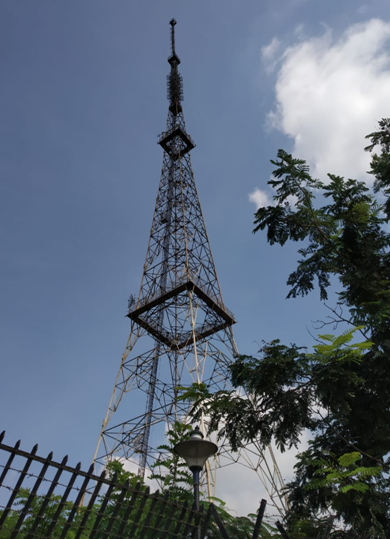
The below figure(fig.2) is the tower which is set up in Chettipalayam station for FM broadcasting and microwave reception. This tower will receive the signal from AIR-Ramanathapuram using microwave antenna and the received signal is boosted to 10KW at the station and via the array antennae, boosted signal is broadcasted to all around Coimbatore. This tower is also shared by “Hello FM - 106.4MHz”. In this tower, two types of antennae are used. One is microwave antenna(fig.3) which is used for receiving signal from AIR-Ramanathapuram and other is array antenna(fig.4) which is used to transmit or broadcast FM signal,


Fig. 2 : Tower - Chettipalayam station

The below figures(fig. 3 and fig.4) shows the two types of antennae placed in the tower. This tower is located in Chettipalayam station.


Fig. 3 : Microwave antenna


Fig. 4 : Array antenna

Tuesday, March 31, 2020

HAM RADIO IN AVIATION

HAM RADIO IN AVIATION

Amateur radio has truly revolutionized the world of communication. Following its universal usage in all sectors, it has also made its way into the aviation industry. Let us dive into how HAM radio is doing marvels in the aviation sector. How many of you actually know that there’s a specific band allocated for amateur radio in civil aviation? This particular band is called Air band or Air Craft Band. It operates in the VHF region and is used for air navigation and air traffic control. The frequency range employed here is 108 to 137 MHz.
HAM radio in military aircrafts and search and rescue operations
HAM radio is widely employed by search and rescue airplanes to establish communication between the rescuers and the victims. The communication is mainly made in the VHF band. The international distress frequency is used by amateur radios to establish emergency radio communication. It is licensed by an international agreement. These are the frequencies commonly used by military and civilian aircrafts for various communication and detection systems.
The International Air Distress frequency is 121.5 Mhz. Emergency locator beacons use this frequency for navigation purposes and to indicate distress.
NATO (North Atlantic Treaty Organization) military airplanes use the frequency 243 MHz.
Corpas Sarsat is a best known Canadian search and rescue programme that utilizes a group of satellites in orbiting earth to provide distress alerts. It actively utilizes amateur radio frequencies and send these alerts to search and rescue authorities. It operates at a frequency of 406- 406.1 MHz.
Amateur radio in high altitude balloons (‘the poor man’s space program’)
The process of tracking high altitude balloons such as weather balloons near space with the help of amateur radio is called Amateur Radio High Altitude Ballooning (ARHAB). The balloons can be tracked using data transmissions or APRS. The tracking equipment containing camera and sensors is sent up to high altitudes of about 30 km. At a distance of 1 metre, the balloon expands and the payload (camera and sensors) fall to the ground with the help of a parachute.
Emergency Position indicating radio-beacon station
It is a type of radio-beacon station that is powered by a radio transmitter to indicate the position of missing airplanes, vessels or people in distress. In case there is an airplane crash, the radio transmitter begins emitting a radio signal that is received by search and rescue teams that come for immediate rescue. The main purpose of this system is to help the survivors of a traumatic plane crash within ‘the golden day’. It is a period of 24 hours following the event. The operating frequency is 406 MHz.
These revolutionary mechanisms in amateur radio help the aviation sector in different ways to monitor airplanes and other vessels in times of disaster and air traffic control.

Tuesday, March 24, 2020

AMATEUR RADIO IN MARINE

AMATEUR RADIO IN MARINE


In marines, Marine single side band(SSB) radios are preferred to Ham radios for communication .Choosing between either of them depends on an individual.The Marine MF/HF-SSB radio is a transceiver more like a VHF radio.The main difference is in its operating frequency.Marine radios operates in the range of 1.6MHz-30MHz.In VHF radios there is only line of sight communication,while the MF/HF radios refract the signals within atmosphere hence providing increased range and long distance ship to ship or ship to shore communication.

When the distance of communication is more than 30 NM,the MH/HF radios maintain the communication lifeline .Along with the long distance communication the SSB radios provide with options like email, teletype and weather
facsimile .The recent SSB radios allow access to amateur frequencies for those boaters with license.Since HF radios use lower frequencies to communicate over long distance at relatively low cost they are most popular for blue water passage maker or world cruiser.
       
       Propagation is one of the key factors which helps HF radios in effective communication.Propagation is simply the reflection or refraction of radio waves in the layers of ionosphere.Ground wave propagation is ideal for lower frequencies (up to 3MHz) and relatively short distances during daytime (100-200NM) and up to 400NM at night.In sky wave propagation the signals refract through a layer of ionosphere and then back to the earth.Hence longer distances can be achieved,often thousands of miles during the day and several thousands miles at night.


Conditions to be considered in frequency selection are

The higher the sun above the horizon the higher the frequency you will need to communicate.
For the same frequency you can generally communicate further at night than during the day.
Winter are preferred to summer for improving the distance you can communicate.

The higher the frequency, the further you can communicate.


As a general rule, ship to ship communications are carried out on simplex frequencies where both transmit and receive frequencies are the same. Duplex frequencies on the other hand are intended for use as ship to shore frequencies although simplex frequencies can also be used for this purpose.


LICENSING

In order to use a marine SSB the ship needs a call sign from the federal communication commission(FCC) ,called a station license which is good for ten years.One also need to obtain an operator’s permit,called restricted operator permit,a lifetime license to use SSB marine radio abroad.

Tuesday, March 17, 2020

AMATEUR RADIO IN DEFENCE SERVICES

AMATEUR RADIO IN DEFENCE SERVICES

          The dot and dash communication through amateur radio in military services started from the world war era.During the world war-I, the radio communications seemed to be the most critical mode of communication. An organistion was formed in the name of AUXILLARY AMATEUR RADIO SYSTEM (AARS) by the United States army signal corps. This was more helpful in gathering the manpower and war equipments during the 1st world war.The AARS employed accomplished amateur radio enthusiasts.The AARS was a partially successful effort.
          The AARS was reborn in the name of MILITARY AFFILIATE RADIO SYSTEM. This was due to the growing number of civilian service volunteering of people.Eventually Navy-marine operations ,separate army and air forces with MARS began on 1st January 1963. MARS served its best during the Korean war,Vietnam war and the Gulf war helping the servicemen to contact their  families from oversea areas. The program again changed its name to MILITARY AUXILARY RADIO SYSTEM and continued its services. MARS is an active body till date and extends its support to the defence and military departments to the fullest of its ability.


DIGITAL MEDIA DISCRIPENCY

         Having a digital media portal falls into both the pro and con aspects for any country’s defence and military departments. However there are laws framed that restrict the usage of social media platforms by the soldiers.the digital media keeps the soldiers in contact with their family and friends and provides numerous benefits even after the retirement of the army person.But the con aspects dominate more in this case. Operation security is the major thing that gets affected when the soldiers share their location.The digital media allows a person to post anything of his/her heart’s desire,which will not be suitable for an army personnel.
          Defence services cannot depend only on electronic communication. At times face to face communications are necessary but that does not serve to be a confidential platform. Making the soldiers understand the consequences of posting things would compensate the the con effects of the digital media platform.Here comes the saviour of military secrets i.e. the amateur radio communication


MILCOM MONITORING RECIEVERS:

      Usually milcom frequency ranges are not published. For monitoring the mil com activities one must search the frequency range of 225-380MHz. Monitoring the civil air band is quite a difficult job as the conversations are much shorter or sometimes in Morse codes. One could also monitor 380-400MHz frequency range for areo operations during the war times.There are many Milcom monitoring equipment , antennas and SDR are being setup to monitor the milcom activities.But it is very difficult to search the whole band of frequencies.

         The military details are much confidential and hence much information regarding the VHF and UHF bands are not disclosed. The MARS and other such organizations serve to be a point of contact to the soldiers and the public. The HAM enthusiasts serve the defence by capturing the frequencies of the terrorists and the anti world peace organizations. Therefore the HAM serves to be a great hobby and matter of serious business. 

Monday, March 2, 2020

Amateur radio in space

Amateur satellite service is a project sponsered by various entities and carried out by astronauts and cosmonauts on International Space Station who have license. Shuttle Amateur Radio Experiment (SAREX) was its previous name.
Amateur radio operators all over the world speak with astronauts with the help of  their mobile, home radio stations. To establish communication low power radios and small antennas can be used. Even with the help of laptops it is possible to send digital data to space station.
The space station occupants while working have breaks. During break, some of them spend time communicating via amateur radio.
With the help of amateur radio, we can communicate with astronauts in space. This is very useful to students as they get connected with astronauts so that they could learn more new concepts and develop their knowledge.
How to Call Space Station Astronauts on the Radio?
A ground station contains a device capable of both transmitting and receiving radio waves near the 145 megahertz frequency. The ISS radio transmits signals at 145.80 MHz and receives signals at either 144.49 or 145.20 MHz, depending on its orbital location.
During the 10-minute communication sessions, Ransom said, students usually ask the ISS crew what they do in their free time, where they are and what it looks like out their window.
Thus amateur radio in space is very useful and is one among the best methods to communicate with astronauts in space.


Tuesday, February 25, 2020

History of Ham

The birth of amateur radio starts, of course, with the invention of the radio. There are many contributors to the birth of radio such as Guglielmo Marconi, Nikola Tesla, ect. Brilliant Scottish scientist named James Clerk Maxwell set the next foundations in place.Maxwell was a theoretical scientist and sought to express physics in terms of mathematical relationships.
Maxwell's work culminated in 1873 with the publication of a book called "A Treatise on Electricity and Magnetism". In this he developed equations, now known as Maxwell's Equations that defined electromagnetic waves.

 No matter who gets the credit, one thing is clear, these first radio operators were the pioneers of amateur radio. In fact, by 1909, the first amateur radio club, The Junior Wireless Club, was organized in New York. The earliest transmitters consisted of spark transmitters and these continued to be used for many years. It was only in the 1920s with the cost of valves / tubes coming down that spark transmitters stopped being used. The phenomenon of radio waves gained a lot of publicity - the fact that signals could travel between two points with no wire even held a form of magical mystery and public demonstrations were sometimes given. These factors provoked people to learn about radio communication and to become radio amateurs.

In the early days in the history of ham radio it was not envisaged quite how radio would develop. Anyone was allowed to transmit and there was no regulation. However as radio started to be used for commercial uses it was agreed that licensing would be required. In the UK licenses started to be issued in 1904, and this occurred around the same time in many other countries. Callsigns also started to be issued, but this occurred a little later. As the years passed, the history of amateur radio showed that technology developed and new techniques were used. However the same pioneering spirit of some of the early radio amateurs was retained, with many radio hams contributing to the development of technology in many ways.

Events:
 It was the sinking of the RMS Titanic on April 15, 1912 that prompted new international radio laws which also affect amateur radio, including frequency restrictions and operating procedures.

World War I: By 1917, World War I had put a stop to amateur radio. In the United States, Congress ordered all amateur radio operators to cease operation and even dismantle their equipment.These restrictions were lifted after World War I ended, and the amateur radio service restarted on October 1, 1919.

World War II: During the German occupation of Poland, the priest Fr. Maximilian Kolbe, SP3RN was arrested by the Germans. The Germans believed his amateur radio activities were somehow involved in espionage and he was transferred to Auschwitz on May 28, 1941. After some prisoners escaped , the Germans ordered that 10 prisoners be killed in retribution. Fr. Kolbe was martyred when he volunteered to take the place of one of the condemned men. He is considered the Patron saint of Amateur radio operators.
Again during World War II, as it had done during the first World War, the United States Congress suspended all amateur radio operations.