Tuesday, January 21, 2020

Yagi-Uda antenna


Yagi-Uda antenna


Yagi-Uda antenna is the most regularly utilized kind of antenna for TV reception, many other domestic and commercial applications. It is an electromagnetic device that collects radio waves.The Yagi-Uda antenna derived its name from its two Japanese inventors Hidetsugu Yagi and Shintaro Uda.
It is mostly known for simple utilization and better execution. Itis highly appreciated for its high gain typically greater than 10 db and directivity. The gain and directivity of the Yagi antenna enables the receiving capacity by improving better degrees of noise ratio to be accomplished, and by reducing interference levels by just getting signals from a provided direction. The frequency of this antenna extends around 30 MHz to 3GHz which is of the VHF and UHF band range and covers about 40 to 60 Km.

Fig: 1 Yagi-Uda antenna


Construction of Yagi-Uda Antenna:

A Yagi-Uda antenna was seen over pretty much every house during the past decades. The parasitic components and the dipole together form a Yagi-Uda antenna. The Yagi antenna design has a dipole as the principle transmitting driven element to which power is applied from a feeder.
The ‘parasitic' components draw power from the driven element and re-radiate it. The stage is in such a way, that it influences the properties of the entire Yagi antenna on the whole, making power be focussed one specific direction and expelling out other directions.
The amplitude and phase of the current that is induced in the parasitic components is decided on their length and the spacing among them and the dipole or driven component. In this event if a component is longer than the resonant length, it gets inductive and shorter, it gets capacitive.


Fig: 2 Components of Yagi-Uda Antenna


There are three kinds of component in a Yagi antenna:

   1. Driven element:
 It is the Yagi antenna component to which power is applied and is a half wave dipole.

   2. Reflector:
 The reflector component is made to be about 5% longer than the driven element and it will have one reflector. It is behind the driven component.
Further reflectors behind the first make no difference to the reception apparatus performance. The reflecting plate gives a slight improvement in execution.


   3.  Director:
These are made to be shorter than the driven element. There might be none, one or more directors in the Yagi reception apparatus. These are put before the driven element, toward the maximum sensitivity. Normally every director will include around 1 dB of gain in the forward direction.


Designing:


For designing this antenna for the given frequency, the following design specifications are should be followed.


Fig: 3 Designing specifications 

Radiation Pattern:

The directional pattern of the Yagi-Uda antenna is highly directive and the radiation patterns are:

Fig: 4 Radiation pattern

The minor lobes are suppressed and the directivity of the major lobe is increased by the addition of directors to the antenna.
The antenna exhibits a directional pattern consisting of a main forward lobe and a number of spurious side lobes. The main one of these is the reverse lobe caused by radiation in the director of the reflector. The antenna can be optimised to either reduce or produce the maximum level of forward gain.

Advantages:

The Yagi antenna offers numerous advantages over different sorts of antenna in numerous applications.
  • High gain is achieved.
  • High directivity is achieved.
  • Ease of handling and maintenance.
  • Less amount of power is wasted.
  • Broader coverage of frequencies.

Disadvantages:

The negative factors that needed to be taken care while constructions of Yagi antenna are:

  •  Long for high gain
  •  Prone to noise.
  • Prone to atmospheric effects.


Saturday, January 4, 2020

Fox Hunt

FOX HUNT:

Transmitter Hunting, or (T-hunting, fox hunting, bunny hunting, and bunny chasing), is a popular way to combine outdoor activity with the amateur radio hobby. The "Fox" hides a hidden transmitter, and the hunters use direction-finding techniques to locate it. To a radio amateur (or “ham”), fox hunting has nothing to do with animals. It is a sport in which individuals race each other to locate a hidden radio transmitter on a known frequency. Since hams are encouraged to design and build their equipment, the typical fox hunt involves a variety of different receivers and antennas with different capabilities. Some of these can display the received signal strength from the hidden transmitter (loosely measuring distance to the transmitter), while others estimate the compass bearing.

Both of these estimates vary in accuracy and precision depending on terrain, environmental conditions, equipment quality, and the skill of the operator. Fox hunting also serves the purpose of preparing radio amateurs for emergency or disaster operations. Because disaster operations require the concerted efforts of multiple radio operators, it seems fitting to explore how the sport changes if fox hunting becomes cooperative.                                                                                   


When participants combine their estimates of distance and bearing, how much faster can they find the transmitter?
Part of the challenge of fox hunting is that measurements are taken infrequently, only once every few minutes. To win the hunt, every minute must count! In the most demanding scenario, each sensor only gets to take one measurement of the fox transmitter. Locating the fox transmitter from a collection of different sensors is a model-based data fusion problem: combining disparate local observations into a global inference. Without a model that describes how signals from the transmitter arrive at each receiver, the signal reports do not help locate the transmitter. Even with such a model, the effects of terrain, the transmitter’s antenna system, and the environment can cause substantial differences between the modelled signal and an actual received signal. Therefore, we must  remain even-handed about assumptions of the quality of the estimates and the quality of the model.
There are several types of transmitter hunts. Transmitter hunting is pursued in several different popular formats. Many transmitter hunts are organized by local radio clubs and may be conducted in conjunction with other events, such as a radio enthusiast convention or club meeting. Before each hunt, participants are informed of the frequency or frequencies on which the transmitters will be operating, and a set of boundaries that define a search area in which the transmitters will be located. Transmitter hunters use radio direction finding techniques to determine the likely direction and distance to the hidden transmitter from several different locations, and then triangulate the probable location of the transmitter. Some hunts may include limits on the amount of time allowed to find a transmitter. Although many transmitter hunts are conducted just for the fun of the activity, some more competitive hunts will recognize winners in publications and offer awards, such as medals or trophies.

Few of the most famous Fox-hunt types are:

1)Mobile transmitter hunts:

Mobile transmitter hunts are organized events where participants travel exclusively or primarily in motor vehicles. Most mobile transmitter hunts use VHF transmitters and receivers.
Some participants use radio direction finding equipment and antennas mounted on a vehicle, whereas others use antennas that are temporarily deployed in an open window or an opening in the vehicle roof that can be easily rotated by hand while the vehicle is in motion. Other participants employ handheld antennas and radios that can only be used when the vehicle is stationary. Some mobile transmitter hunts require participants to leave their vehicles and proceed on foot to reach the actual location of the radio transmitter. The winner of a mobile transmitter hunt can be either the first vehicle to arrive at the hidden transmitter, or the vehicle that travels the shortest overall distance to locate the hidden transmitter. Mobile transmitter hunts are more popular in North America than in other parts of the world.

2)Pedestrian transmitter hunts:

A regulated sport form of transmitter hunting by runners on foot is called Amateur Radio Direction Finding, known worldwide by its acronym, ARDF. It is an amateur sport that combines the skills of orienteering and radio direction finding. ARDF is a timed race in which individual competitors use a topographic map and a magnetic compass to navigate through a diverse, wooded terrain while searching for hidden radio transmitters. ARDF is the most popular form of transmitter hunting outside North America.

3)Fixed location transmitter hunts:

Some transmitter hunts feature a "mail-in" competition, in which teams in fixed locations work together to locate hidden transmitters, then secretly give the coordinates to the organizers without actually traveling to the transmitter location. The team which provides the closest coordinates wins, thus a team which believes that the transmitter is in the northwest parking lot at 2nd and Elm (if it is there) will beat a team which says that the location is 2nd and Elm. This type of hunt enables participation by contestants who are unable to travel, such as shut-ins, school groups, etc., and requires a greater level of skill and coordination.

x

Monday, December 30, 2019

SOFTWARE DESIGNED RADIO

TIDES OF SOFTWARE DESIGNED RADIO

SOFTWARE DESIGNED RADIO

Software designed radio is a radio communication system where components that have been traditionally implemented in hardware are instead implemented by means of software on a personal computer. While the concept of SDR , the rapidly evolving capabilities of digital electronics render practical many processes which were once only theoretically possible.
A basic SDR system may consist of a personal computer equipped with a sound card, or other analog to digital convertors, preceded by some form of RF front end. Significant amounts of signal Processing are handed over to the general-purpose processor, rather than being done in special-purpose hardware.


APPLICATIONS OF SOFTWARE DESIGNED RADIO
The SDR concept is applicable in various areas

•MOBILE COMMUNICATION
                    Software defined radios are very useful in areas such as mobile communications. By upgrading the software it is possible to apply changes to any standards and even add new waveforms purely by upgrading the software and without the need for changes to the hardware. This can even be done remotely, thereby providing considerable savings in cost.

•RESEARCH AND DEVELOPMENT
       The radios can be configured to provide the exact receiver and transmitter requirements for any application without the need for a total hardware design from scratch.

•MILITARY
          The military have made much use of software defined radio technology enabling them to re-use hardware and update signal waveforms as needed.

•OTHERS
          There are very many other applications that can make use of SDR technology, enabling the radio to be exactly tailored to the requirements using software adjustments.

ADVANTAGES OF SDR
It can perform at high rate.
Performance can be changed by upgrading the software.
It is possible to reconfigure radios by updating the software.
The same hardware can be used for several different radios.

DISADVANTAGES OF SDR
Analogue to digital converters limit top frequencies that can be used by the digital section.
For very simple radios the basic platform may be too expensive.
Development of a software defined radio requires both hardware and software skills.


Monday, December 23, 2019

PERKS OF HAM LICENSE


PERKS OF HAM LICENSE


HAM LICENSES

Any individual above the age of 12 can become HAM after qualifying Amateurs station operators examination and they can access a valid Amateur wireless telegraph station license. There are three types of license for HAM radio operators: Technician, General, and Amateur Extra. The license is valid for 10 years and you can renew it without taking an examination.

TECHNICIAN LICENSES

         All HAM starts with Technical license and it is also called as Tech license. These license holders are allowed to access for all HAM band with frequencies 50 MHz and above.  These privileges include operation at the maximum legal power limit and using all types of communications. They can transmit using voice on part of the 10 meter band and Morse code on some of the HF bands below 30 MHz. Technician class exam includes 35 multiple choice questions on technical radio topics.

GENERAL CLASS LICENSES

          After piece of pie  the entry-level Technician license, many HAM starts getting upgraded to General class licenses. General class licensees have full privileges on nearly all amateur frequencies, with only small portions of some HF bands remaining off limits.General class exam consists of 35 questions in which the topics are similar to Technician class but in more detail, and you are also introduced to some new topics.

AMATEUR  EXTRA CLASS LICENSES

            General class licensees still can’t access everything; the lowest segments of several HF bands are for Amateur Extra class licensees only. These segments are where the expert Morse code operators hang out and are considered to be prime operating territory. The Amateur Extra Class consists of 50 multiple choice questions out which 37 questions must be answered correctly to pass the examination.  The exam covers rules and regulations associated with sophisticated operating and several advanced technical topics.

WHAT CAN ONE DO WITH THE LICENSE

  •          You can talk to other HAM.
  •          You can build radio and antenna.
  •          You can participate in fox hunt event.
  •          you can transmit and receive pictures.
  •          you can experiment with satellite communication.

According to the survey on April 2013 nearly 48.7% are  Technician license holders. Nearly 23.1%  are General Class license holders and about 18.5% are Amateur Extra Class license holders.


Sunday, November 3, 2019

Role of amateur radio in Disaster Management

Role of amateur radio in Disaster Management: the unsung heroes


Disasters, both natural or man-made, do happen. A lot more often than needed. But we as humans have evolved pretty well to cope and improvise according to these situations. But our evolution may also be a curse in disguise.

As we have grown more and more tech savvy, we also became more and more dependent on tech. So much to a point where it's literally life or death. We use it for information, navigation, communication and much more. The problem arises when we suddenly lose access to this tech.


Let's take a calamity for instance. Such as the flood that occurred in Chennai. The rains were heavy and unstoppable. Hard and unbelievable. Annoying and unfathomable. The rich and the poor were united. There are only two types of people at a time like that. You either survive... Or you die.


At times like these the basic human requirements become a luxury. We no longer take it for granted. This includes water, food, shelter and technology. As discussed before, technology is vastly prevalent in communication. So that means no more calling with a phone, TV, Internet and radio... Except, we can still use radio with a few minor adjustments.
Amateur radio is similar to traditional radio broadcasting. Except they don't use for commercial purposes. They may use for other reasons such as entertainment, recreation, education, self practice, radiosport, and finally and most importantly, communication.


We use radio waves to send and receive audio over vast distances. This audio can be Morse code or even full fledged analog sentences. But during disasters, we don't really need to have giant antennas, since these calamities usually only happen within a few districts. So we can easily use small, compact and inexpensive gear to send and receive radio messages.


At a time when disaster strikes, and communication is down. We will need to get in contact with the people in charge in various parts of the affected city. If we need to rescue stranded citizens, we can't call the search and rescue on our phone. If there is a fire, we cannot call the fire department. If there is an injury, we cannot call an ambulance. If there is a problem, we cannot just call the police. It is in these situations where we need operators who contact these different departments during an emergency.
Therefore, the government sends a call for all the amateur radio operators in the vicinity and brief on the current situation. They are then stationed on different parts of the affected city. When there is an emergency, the people can tell these operators. These operators will then contact the police or other disaster relief departments and let them know what the problem is and where to come.


Hence, these amateur radio operators are a vital link between the affected people and the authorities. They risk their lives voluntarily to go to these dangerous places from the comfort of their homes to connect the people to their required help. They are unsung heroes. 


Sunday, October 13, 2019

ANTENNA

As the developed of electronics increased in recent years, scientists and engineers have found a way to eliminate the use of traditional antennas such as Yagi antenna,Rabbit ear antenna etc.But the antennas aren't going anywhere,they are replaced by new technologies.Although antennas are generally considered to be outdated, telecommunication  companies are finding ways to innovate the antenna for next generation of electronics. As antennas are smaller, lighter,and more powerful than ever before they are used in wide areas such as 3D printers and manufacturing technique.
                                              
An antenna is a transducer that changes over radio frequency (RF) fields into alternating current or the other way around. There are both receiving and transmission antennas for sending or accepting radio transmissions. Antennas assume a significant job in the activity of all radio hardware. They are utilized in remote networks, portable communication and satellite correspondence.


                                  Related image

They are arranged with metallic conductors where the electrical connection are given to the receivers and transmitters. Current is passed through these conductors and an alternating magnetic field is created.They induce voltage to the antenna.The magnetic field is coupled with similar oscillating electric field.It allows electromagnetic waves for propagation.

WHY DO WE NEED ANTENNAS?


There are several reason for using these antennas but the important reason is to provide a simple way to transfer signals when other methods are impossible.Working of any wireless device requires transmitting and receiving signals(or data) this is only possible with the use of antennas.There are many situation in which cables are preferred over wireless communication with antennas(like high speed Ethernet or the connection between gaming console and the T.V., for example).  

Stay tuned to learn about the types of antennas which will be posted next week.

Wednesday, October 2, 2019

Radio Frequency

RADIO FREQUENCY

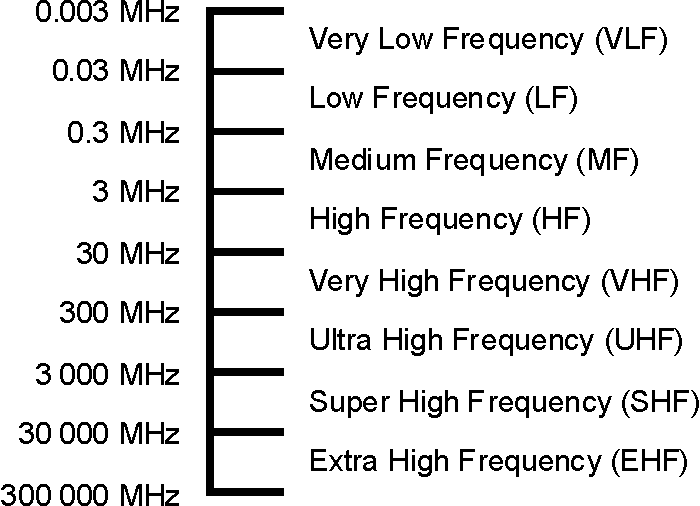
Radio frequency is the activity representing the oscillation rate of  electromagnetic radiation spectrum, electromagnetic radio waves, from frequencies starting from 300GHz to as low as 9kHzRadio frequency is measured in units called hertz, which represent the number of cycles per second when a radio wave is transmitted. One hertz equals one cycle per second. The unit Hertz is named in honor of the 19th-century German physicist Heinrich Rudolf Hertz.  With the utilization of antennas and transmitters, an RF field can be used for various types of wireless broadcasting and communications.


When it involves choosing  the right radio, the difficult task is to choose the right bandwidth to be utilizedthe 2 major wavelengths used for communications are VHF (Very High Frequency) and ultrahigh frequency (Ultra High Frequency).

Image result for vhf radio range

VHF

VHF’s frequency range is from 30 MHz to 300 MHz. VHF has 10 times longer wavelength. This means the waves are longer with VHF therefore it travels further. The VHF radio band specifically for commercial radios is between 130 -174 MHz. If you're operating largely outdoors, a VHF radio maybe the most effective selectionparticularly if you are employing a base station radio inside and you add the external antenna. The higher you can place the antenna, the further you can transmit and receive.VHF radios also have a smaller number of available frequencies.One benefit of VHF wireless radios is that battery life is almost always better than for similar UHF units. For handheld radios this is a plus.The VHF band is used for two-way radio communication. a good deal of satellite communication and broadcasting is done at VHF.

                               
                                    Image result for ultra high frequency

VHF waves, not like longer waves, are not strongly reflected from the atmosphere; thereforethey don't bend  round the Earth’s curvature and cannot  be transmitted beyond the horizon. VHF waves are  restricted to use in short-range, line-of-sight communications, together with radio and television broadcasting, and in electronic navigation systems.

UHF


Ultra high frequency (UHF) refers to the band of  electromagnetic radiation with a frequency varying  between 300 MHz and 3GHz. This band is also called as the decimetre band, with a wavelength starting from 1 m to dm. UHF is used for data transmission with shorter wavelength and high frequency. Since the size of antenna is directly proportional to the size of the waves, the antennas for UHF are short and stout. Higher the frequency band lower the size of antenna.The broadcast range is shorter than VHF.


UHF is used in two-way navigation, wireless local area network and communications, radio and security systems.

For example,  When you’re in an area with lots of small obstacles, such as a circle track or stadium race where there’s lots of people, you’re going to need a signal that can travel in between gaps of those obstacles to the receiver you’re talking with. This is where UHF signal will provide a greater range because of the smaller waves. VHF is suitable for wide range, but in this case UHF is used for better transmission quality.