Thursday, July 21, 2022

Artificial Intelligence and 5G

    5th generation mobile network. It’s a global wireless standard after the previous 2G 3G and 4G. 5G is a new network that is created to connect virtually everyone and everything together including machines (machine language), objects (such as other smart gadgets), and devices. 5G wireless technology is meant to deliver higher data transmitted in a second (GB per second), with low latency and more reliability. It is uniform user experience to most users. Higher performance and improved efficiency tend new user to experiences and connect to new industries. Click here to continue reading


Free Space Optics Technology (FSO)


The transmission of modulated visible or infrared (IR) beams across the atmosphere to produce Broadband communications is known as free-space optics (FSO), sometimes known as free-space photonics (FSP). Laser beams are most employed, however non-lasing sources such as light-emitting diodes (LEDs) or infrared-emitting diodes (IREDs) can also be used. FSO theory is substantially the same as fiber optic transmission theory. The distinction is that instead of being steered by an optical fiber, the energy beam is collimated and delivered through clear air or space from the source to the destination. Click here to continue reading

Orthogonal Frequency - Division Multiplexing (OFDM)


    OFDM stands for Orthogonal Frequency Division Multiplexing, which separates a high data rate modulating stream into numerous slowly modulated narrowband close-spaced subcarriers, making it less susceptible to frequency selective fading. OFDM is a frequency-division multiplexing (FDM) method developed by Bell Labs’ Robert W. Chang in 1966. To convey data in parallel, OFDM uses several closely spaced orthogonal subcarrier signals with overlapping spectra. Fast Fourier transform algorithms are used in demodulation.Click here to continue reading

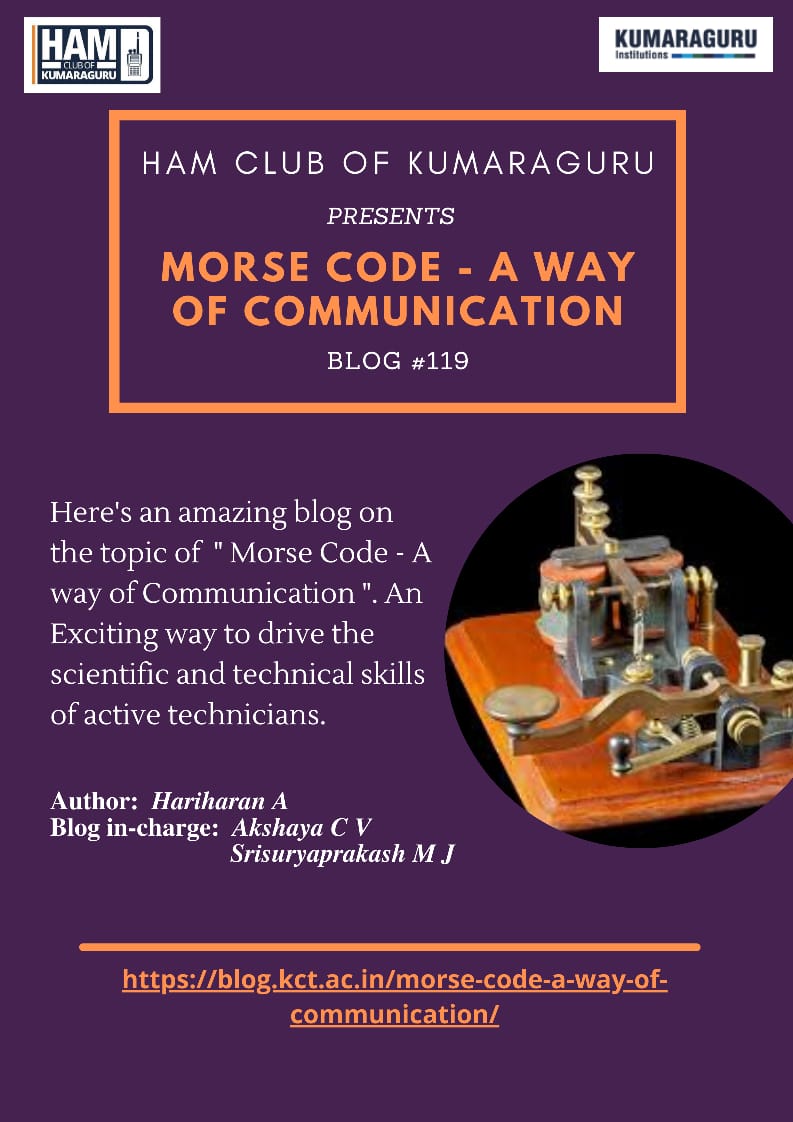
MORSE CODE - A Way of communication


    There are numerous technical definitions, but the gist is that Morse code is one of two systems that allow you to represent alphabet, numbers, and punctuation marks: either through electrical pulses of varying lengths or through visual signals (think flashlight or lights). A series of dots, dashes, and spaces represent the letters, numbers, and punctuation. The International Morse Code is currently used, which was built on the original system created by Samuel F. B. Morse and Alfred Lewis Vail, a code for electrical telegraphy. Click here to continue reading

Wednesday, March 23, 2022

Electrodynamic Tether


Electrodynamic tethers are long, thin conductive cables stationed in space that can be used to induce power by removing kinetic energy from their orbital stir, or to produce thrust when adding energy from an on- board source. In either case, the frictional or thrust force, is produced electrodynamically, through the commerce between moving charges and glamorous fields. From then, we notice that the operation of electrodynamic tethers is confined to elysian objects that have anon-zero glamorous field and ionospheric tube (e.g., Earth, Jupiter, Saturn, etc, not the moon or Mercury, etc).Click here to continue reading


Wireless Local Loop


Wireless Local Loop (WLL) is a generic system that uses wireless links rather than traditional copper wires to connect consumers to the local telephone company's switch. It is also known as Fixed Wireless Access .Click here to continue reading


Tuesday, March 1, 2022

Sigfox


Ludovic Le Moan and Christophe Fourtet founded Sigfox in 2010 with the goal of connecting every object in our physical world to the digital realm. The two French founders created a global Internet of Things network based on low power, long range, and little data that provides end-to-end communication.. Sigfox has been powering a sustainable and connected world since its beginnings, paving the way for the next Internet revolution.Click here to continue reading https://blog.kct.ac.in/sigfox/